
Agentic Coding Is Changing The Way Apps Are Made Forever
App creation is becoming far more democratized with the advent of AI coding tools.

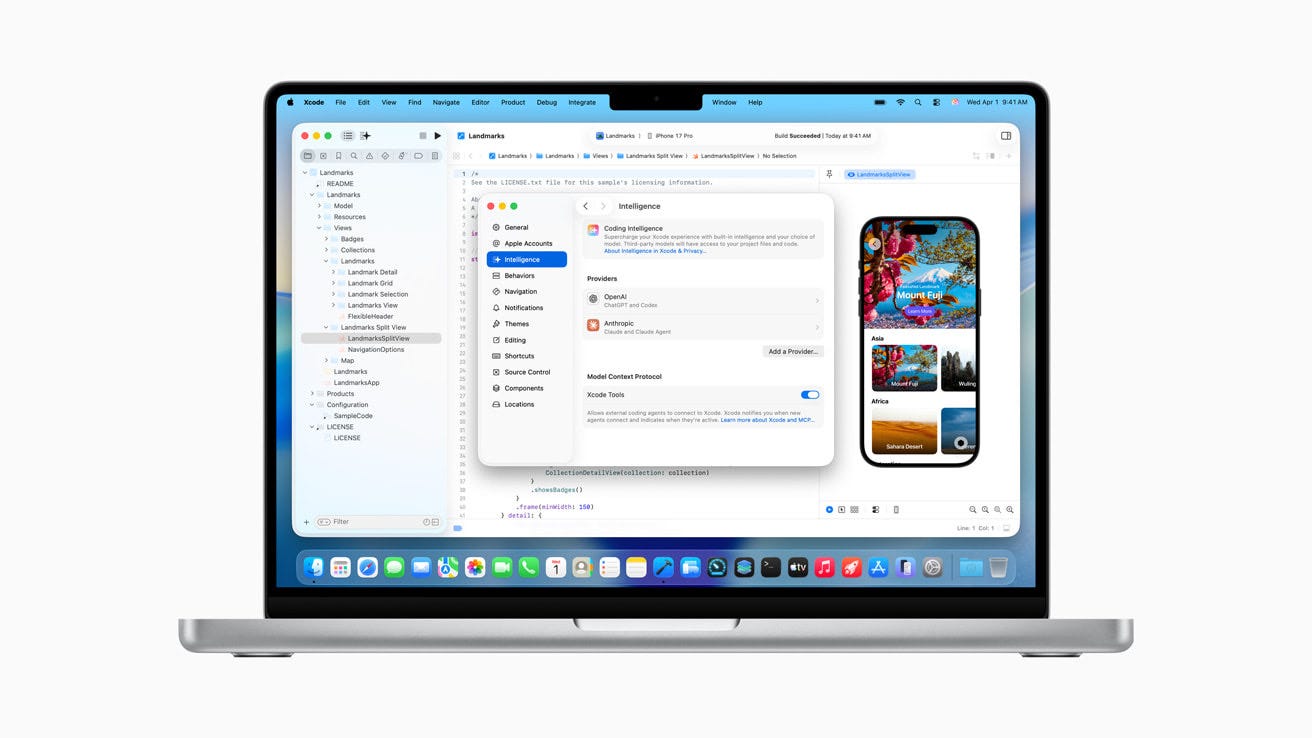
With macOS 26.3, Apple added new agentic coding tools to Xcode that allow users to create code via prompts. I find this very interesting, as I have recently embarked on my own adventure with agentic coding with various web-based AI coding tools on the iPad. I have been working on the design and concept for a web app for several years now, but never was able to get it up and running myself, due to my limited coding ability. But with the help of Base44 (and a very long and detailed prompt describing the entire app UI page by page), my web app idea is now fully functional! I’ve since been experimenting with GitHub CodeSpaces and moving my web app to a more flexible self-hosted system. It’s still a work in progress, but if anyone is interested in seeing this web app, the landing page is here.
But this new adventure of mine has me thinking about what agentic coding could mean for the future of app development. Already with existing tools, not hypothetical tools still off in the future, I was able to take an idea for an app and turn it into working code with limited coding knowledge. I have not tested Xcode’s Agentic Coding tools yet, but by all reports I’ve heard, it seems they work about the same as many of the tools I’ve been experimenting with. I can’t help but think that this is going to pan out to completely revolutionize the way apps are developed in years to come.
The AI Revolution
AI has taken the world by storm in recent years, and while some uses of AI have been overhyped in some cases, I don’t believe that coding is one of them. Of course, AI is not perfect, and you will always get the best results when you know how to use it. The more broad you make your prompts, the worse your results will be. Some basic understanding of how your app needs to work structurally and how it functions is still going to be useful for actually getting good results as opposed to spaghetti code. But the difference here is that you won’t have to learn (and in my case, remember) all the proper syntax for coding elements of your app. This allows more creative-minded individuals to focus on the design of their idea rather than the technical background bits that can be significantly harder and less intuitive to master.
With these tools becoming more abundant and already being incorporated into almost every major IDE code development tool, I think these tools are only going to improve from here and will become far more common. Not only would this make app development more accessible to average people with limited coding knowledge, it is already becoming very useful for developers with more knowledge and experience as well.
AI looks positioned to completely revolutionize accessibility to app development. I would argue on a level similar to the way GUI made computers themselves accessible to the masses. Similar to GUI, agentic coding is taking something that requires memorizing specific scripting and is making it a more visual and intuitive interaction.
Personal Mini Apps?
I’m curious about where AI could take us in terms of device automation. Siri Shortcuts can already be quite “mini app”-like, and Siri Shortcuts have become far more advanced and capable in recent years. What if we were able to create our own custom apps for specific use-cases? Imagine a system similar to Siri Shortcuts, but able to produce entire “mini apps” via prompts.
Like Shortcuts, perhaps these could also be readily shared via an iCloud link, running on a secure platform and frameworks that ensure such mini-apps are private and secure. These apps would likely be limited due to their template-based nature, but could still be more flexible and capable than current Siri Shortcuts.
Again, perhaps this notion is far-fetched, but to me, it seems most of the functionality required for such a system already exists. And I suspect a system similar to this may be what ChatGPT envisions for their rumored hardware platform.
App Development on iPad And Even iPhone?
I could also see agentic coding making app development more possible even within the limited display constraints of an iPhone. Agentic coding could remove several layers of UI complexity, just requiring a prompt field, and some simple editor for tweaking the results manually.
On iPad, already we have Swift Playground which allows users to create Swift-based apps on the iPad, and even publish them to the App Store. Perhaps a streamlined version of Xcode could leverage agentic coding on the iPad, or agentic coding could be integrated into Swift Playground? And such a system could also benefit from being optimized specifically for Swift.
Perhaps creating apps for Apple’s ecosystem will become possible on virtually all of Apple’s primary platforms. Not only would this simplify app development and potentially result in an even larger library of apps available in the App Store, it would also potentially help to unify the app ecosystem across Apple’s hardware platforms.
A Unified App Ecosystem
Over the past few years, there have been several indicators that Apple is moving towards a more unified app ecosystem between their platforms. Swift Code has seemingly been largely at the center of this effort, with SwiftUI automatically optimizing app UIs for Apple’s different platforms. I could see a unified agentic coding solution for Xcode that would automatically create versions for each of Apple’s platforms. Swift and SwiftUI are already compatible with all of Apple’s primary platforms, so this already exists in part.
And beyond ensuring that more apps created with such a tool are cross-platform, this could even prove useful for apps that haven’t been made with Apple’s coding standards and tools. Agentic code is already pretty effective at refactoring code for compatibility with other platforms. This is likely to improve, and in the foreseeable future, I could see Apple providing an AI-powered tool that could convert code designed for other platforms to run on Apple’s devices. We already see some such tools with Apple’s Game Porting Toolkit. I think Apple will continue to provide such tools, making the effort required to port apps over far easier.
And such tools could also be useful for moving existing Mac apps to a more unified system. Perhaps Apple will offer a tool to automatically make a Mac app compatible with iPadOS. Such a tool could possibly even make automatic UI tweaks for touch-optimization for apps that don’t use SwiftUI. Creating an iPad version of a Mac app is doubtlessly becoming easier with Macs and iPads sharing chips and an increasing number of frameworks, but agentic coding may be the final push required in that direction.
Some Potential Downsides
While agentic coding has a lot of upsides, there also can be some downsides as well that may need to be properly managed and addressed. I’ll go into a few of those potential downsides here.
For one, some results may be low-quality. App development with agentic coding will still require proper due diligence to ensure the app functions properly, and to keep bugs in check. While it will reduce the coding barrier, it will not remove the need to maintain apps and develop such software. If people don’t do a good job of maintaining such creations, the quality will inevitably suffer.
And if people create apps without the proper tools, it’s possible you could see higher security risks in some such apps. There are tools to help mitigate this, and the risk will vary greatly based on the type of app. But this could be another potential downside we should not ignore.
The more widespread proliferation of app development tools could also result in more copycat versions of popular apps. We already see some such copycats, and cases of this will likely increase with app development becoming more accessible. This will have to be properly managed and addressed to safeguard and protect intellectual property rights.
The good news is, Apple’s curated App Store system will hopefully help to mitigate a lot of this, though some issues may still make their way through the review process. Apple will need to be mindful of these risks and safeguard against this to protect users and to protect other developers’ work.
Conclusion
While agentic coding will introduce some risks, they largely seem to be outweighed by the benefits. It looks positioned to make app development far more accessible, and will allow far more people to bring their novel software idea to users’ devices.
Prospective app developers will still want to learn the basic structure of apps and how they work, but it will become far easier to create good software without needing to manually write tons of code. I think we’re moving towards a future where individuals will be able to create their own custom apps to streamline and automate their workflow somewhat similarly to Siri Shortcuts. And those who would rather use a pre-built app will be able to find far more of them available in the App Store. I think we’ll see a sort of app renaissance, with many novel and great ideas finally able to come to life without many of the barriers of entry that used to exist. Yes, there are some potential snags, but I think Apple’s App Store system and review process will go a long way toward avoiding many of them.
It will be really interesting to see where these new tools will take us in the coming years.